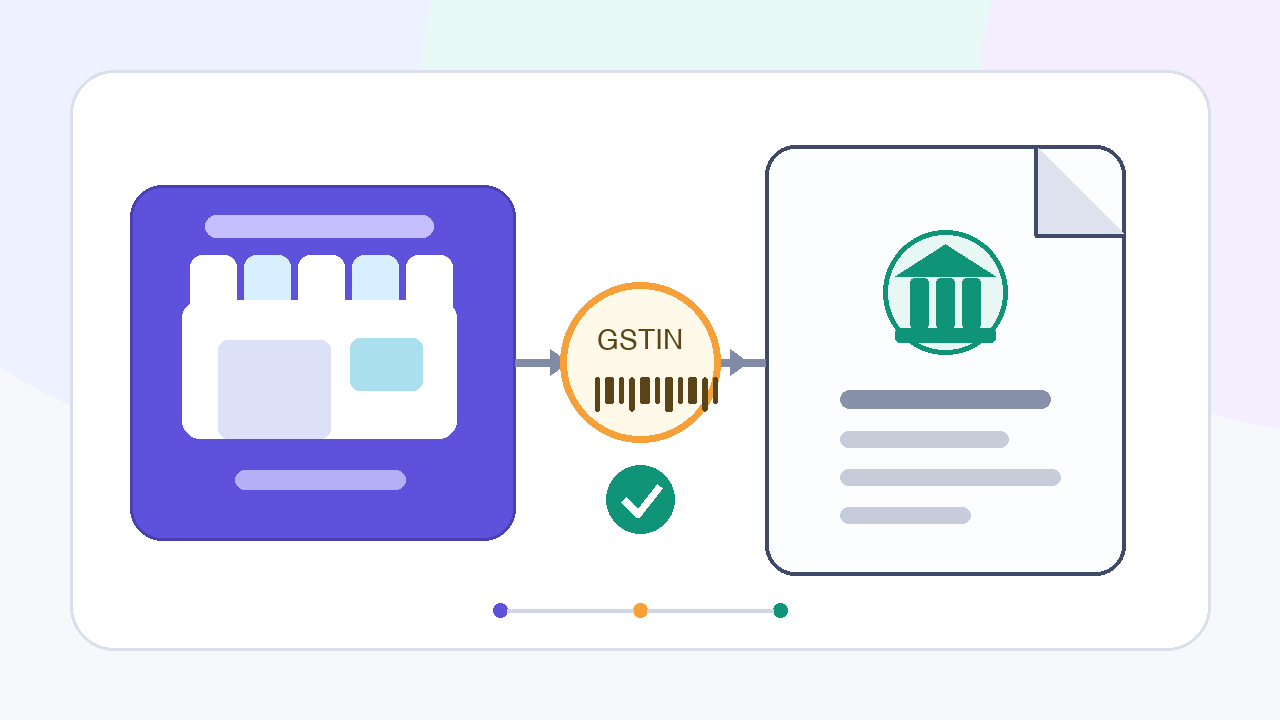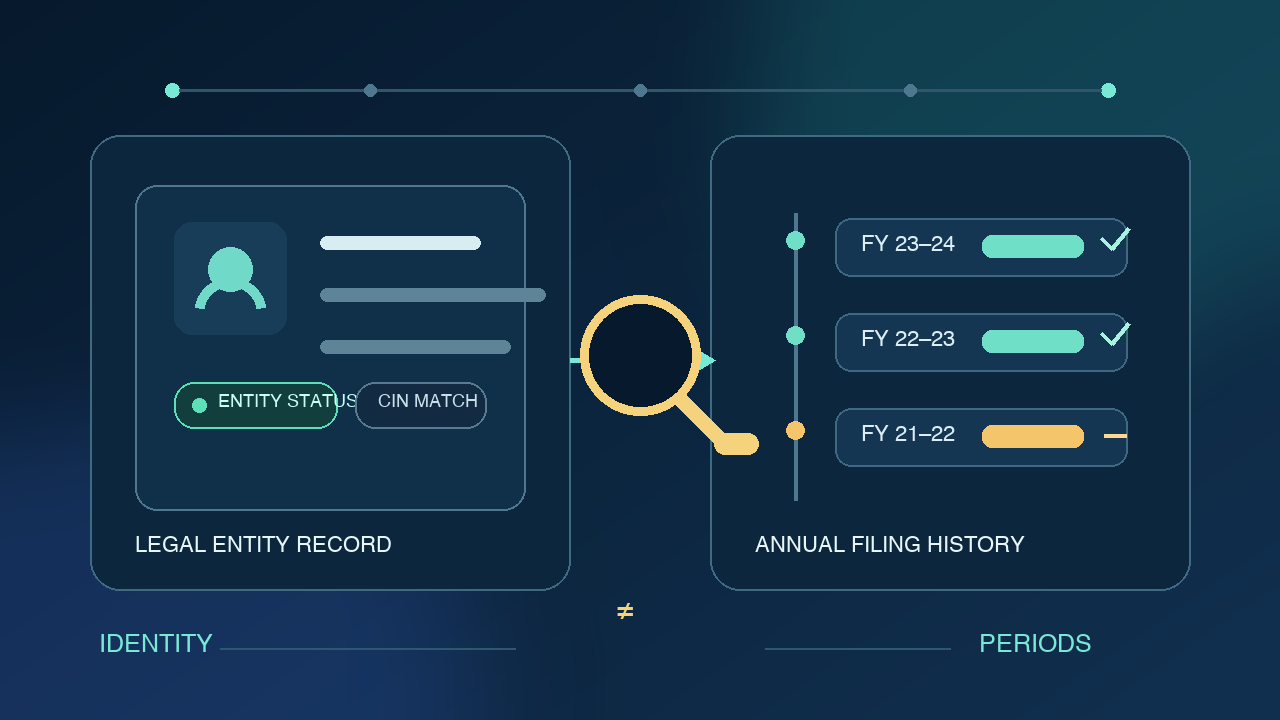
A trademark application is not a registered trademark. For an Indian startup, record the application number, applicant, mark, class, goods or services, filing date and current status as separate fields. Then verify any Journal publication and, only if the Registry record actually shows registration, capture the registration particulars. A filing, examination response, acceptance or advertisement must not be rewritten as “trademark registered.”
This is a public-record research method, not legal advice or a clearance opinion. It does not decide whether a mark is available, valid, infringed, enforceable or safe to use.
The status label answers only one part of the question
IP India provides separate official surfaces for tracking an application or registered mark, searching existing marks and reading the Trade Marks Journal. Those surfaces serve different purposes. A status result is a dated snapshot of one record; a public-search result helps find potentially relevant marks; a Journal entry shows what the Registry published in a particular issue.
Do not collapse them into one green tick.
| Evidence | A bounded conclusion | What it does not prove |
|---|---|---|
| Application number and filing date | An application bearing that number was filed on the displayed date | Registration or exclusive rights in every context |
| Applicant name | The record names that person or entity as applicant | Current beneficial ownership or an unrecorded commercial arrangement |
| Mark and class | The application depicts that mark in the listed class | Protection for every product, service, spelling or logo variation |
| Current status | The Registry surface displayed that procedural status when checked | The complete file history or a final legal conclusion |
| Journal issue and page | The application was published in that issue as displayed | Registration, expiry of all challenge routes or absence of opposition |
| Registration entry or certificate | The Registry recorded registration with stated particulars | Perpetual validity, infringement, market use or title beyond the record |
A safe research sentence is: “IP India displayed application [number] for [mark], filed by [applicant] in class [number], with status [status] when checked on [date].” Add “registered” only when the official record supports that exact word.
Follow the procedure instead of guessing from the label
The official Trade Marks Act, 1999 separates application, acceptance, advertisement, opposition and registration. Section 18 deals with applications. Section 20 provides for advertisement after acceptance, or in some circumstances before acceptance. Section 21 provides an opposition process. Section 23 addresses registration and the registration certificate.
IP India’s processing SOP for trade-mark applications describes the operational sequence in plain terms: an application is examined; it may be accepted or an objection may be raised; an accepted application is published in the Trade Marks Journal; and later steps determine whether it reaches registration.
That sequence is the central fact-checking rule. “Objected” is not the same as refused. “Accepted and advertised” is not the same as registered. “Opposed” means a proceeding exists, not that either side has already won. A registration claim requires registration evidence.
Read an objection as a procedural event
The Registry’s trade-mark practice manual explains that when examination identifies an objection to acceptance, an examination report is sent to the applicant or authorised agent. The record may later include a response, hearing or order.
For public research, capture the objection and its date without predicting the outcome. Do not describe the Registry as having rejected the mark unless the later record actually shows refusal. Do not treat a response filed by the applicant as proof that the objection was overcome.
Treat Journal publication as a traceable milestone
The Trade Marks Journal archive lists issue numbers, publication dates, availability dates and class-group downloads. Record the issue number, publication date, relevant class file and page where the mark appears. Keep a copy of the precise bibliographic details in your evidence notes.
Publication is important because it opens the public opposition stage. Rule 42 of the official Trade Marks Rules, 2017 states that a notice of opposition is filed in form TM-O within four months from publication of the Journal in which the application was advertised or re-advertised. This is a legal deadline; anyone acting on it should obtain professional advice rather than rely on a blog checklist.
Do not infer “no opposition” merely because a quick search found no document. The status portal, correspondence and later Register entry must be checked.
Match the right mark, applicant and class
A startup may use a word mark, stylised logo, product name and company name at the same time. These are not interchangeable. Begin with the exact application number if the startup publishes it. If it does not, search the official public-search surface using the mark and review likely matches rather than stopping at the first similar result.
For each candidate record, compare:
- the exact word or device shown;
- the applicant’s name and address context;
- the filing and claimed-use details displayed;
- the class number;
- the goods or services specification;
- any associated or earlier record mentioned; and
- the current status and its checked-at timestamp.
Class numbers organise goods and services; they do not make every item within a class identical. Preserve the actual specification. A software brand may have records in more than one class, and a similarly named business may own a record for unrelated goods.
The applicant name also needs its own identity bridge. Compare the exact legal name with first-party terms, invoices or an official company record. The MCA company-status and filing method explains why registry identity and filing history should remain separate. If the trademark applicant is an individual, do not publish unnecessary personal details merely because the portal displays them.
A seven-step verification workflow
1. Capture the claim before searching
Write down the startup’s exact statement: “application filed,” “mark accepted,” “published in the Journal” or “registered trademark.” Save the page URL and date. This prevents the evidence from being bent to fit a vague claim later.
2. Find the exact official record
Prefer an application number from a first-party document. Otherwise use IP India’s public search and test spelling, phonetic and relevant class variants. Search results are candidates, not conclusions.
3. Freeze the identity fields
Record the application number, mark representation, applicant, class, goods or services, filing date, claimed-use field and office shown. Preserve the original wording instead of normalising company suffixes or product descriptions.
4. Record the current status with time
Open the official status surface and capture the exact label, visible event dates and checked-at time. A temporary error, captcha failure or OTP barrier is “not checked,” not “no application.”
5. Inspect the procedural history
Where available, review examination reports, responses, hearing notices, orders and correspondence in date order. Separate documents issued by the Registry from submissions made by the applicant.
6. Verify Journal and registration evidence separately
If the record says advertised, identify the Journal issue and page. If the claim says registered, confirm the Register entry or certificate particulars rather than assuming the opposition period passed without incident.
7. Publish the weakest fully supported statement
Use verbs that match the record: filed, examined, objected, accepted, advertised, opposed, refused, abandoned, withdrawn or registered. Add the source and check date. Leave ownership, validity or infringement unresolved unless stronger evidence and qualified analysis support them.
Build a reproducible trademark evidence row
Keep one row per application number:
| Field | What to retain |
|---|---|
| Source identity | Official URL, application number, checked date, time and timezone |
| Mark identity | Word/device representation and any description shown |
| Applicant identity | Exact applicant string and a separate first-party or registry bridge |
| Scope | Class plus complete goods or services specification |
| Timeline | Filing date, claimed-use detail and dated procedural events |
| Examination | Report date, cited provisions and whether a response or order is visible |
| Journal evidence | Issue number, publication date, class file and page |
| Registration evidence | Registration date, certificate or Register particulars if displayed |
| Bounded statement | The exact sentence approved for publication |
| Exclusions | Availability, validity, infringement, title and other untested conclusions |
For a dataset, retain the raw strings and document every deduplication rule. The reproducible startup dataset audit provides a method for freezing sources and transformations, while the source-first verification workflow shows how to keep a public claim narrower than its supporting file.
Stop when the record does not reconcile
Hold or narrow the claim when:
- only a logo image, social post or lawyer’s marketing page mentions the filing;
- the application number cannot be matched on the official surface;
- the mark, applicant or class differs from the startup’s claim;
- the record is objected, opposed, refused, abandoned or withdrawn but the site says registered;
- Journal publication cannot be tied to an issue and page;
- a word-mark filing is used to claim every logo or spelling variant;
- an old status screenshot is presented without a fresh check;
- personal details would be copied without a clear public-interest need; or
- the conclusion requires legal advice about ownership, validity or infringement.
Do not “fix” a mismatch by switching to a different application with a similar name. Preserve both records and leave the relationship unresolved.
The 12-point publication checklist
- Save the startup’s exact claim and first-party URL.
- Use the official application number where available.
- Search spelling, mark type and relevant classes.
- Record the exact applicant name.
- Preserve the full goods or services specification.
- Capture filing, use and procedural dates separately.
- Quote the current status exactly with a check timestamp.
- Distinguish Registry documents from applicant submissions.
- Cite Journal issue and page for an advertisement claim.
- Require a Register entry or certificate detail for a registration claim.
- Remove unnecessary personal information.
- State that availability, validity and infringement were not determined.
Founders assembling a public profile can pair this check with the startup directory submission checklist. SuperLaunch’s editorial policy explains its sourcing, corrections, privacy and commercial-separation rules.
The practical rule
Treat every Indian trademark statement as a stage-specific, class-specific and date-specific claim. Start with the exact application number, preserve the applicant and specification, read the procedural history, and verify Journal publication separately from registration.
If the official record says only filed, objected, accepted or advertised, use that word. Call a mark registered only when the Registry record supports it.