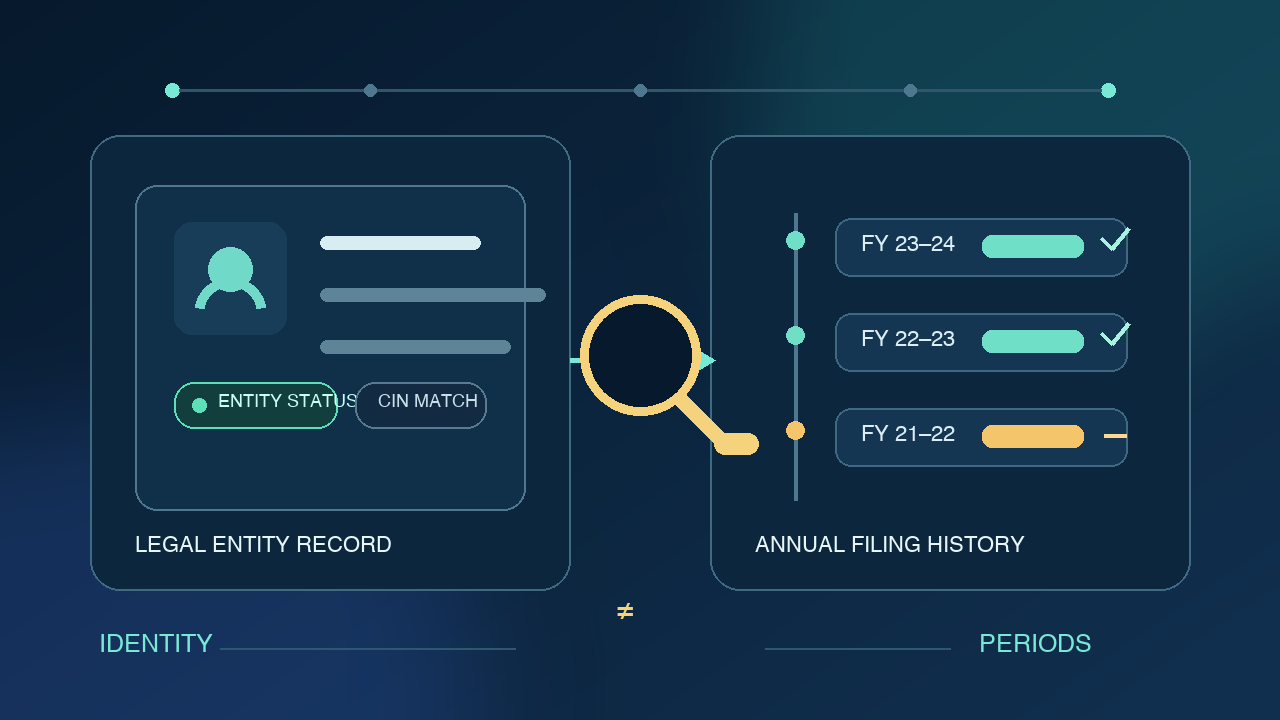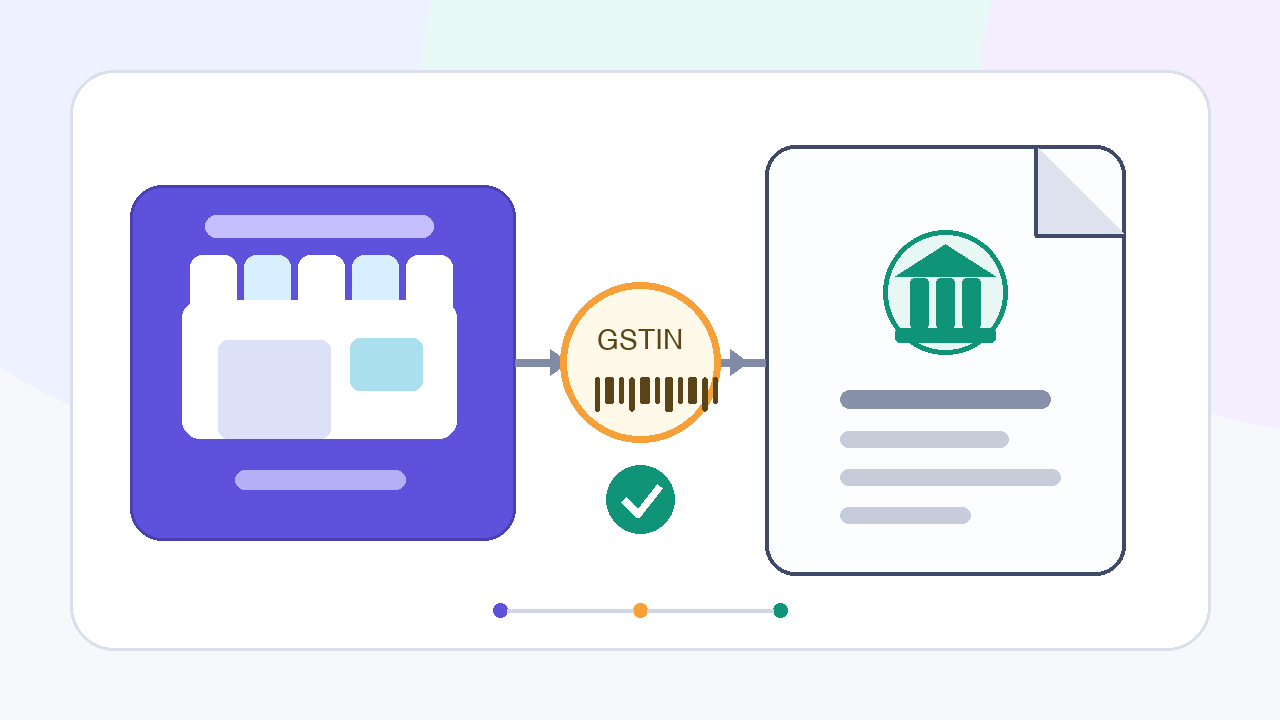
A startup’s GST trade name is not its legal name. The GST registration process takes the legal name from the PAN record, while trade names are entered separately and may include additional names. When you use a GST record to identify an Indian startup, capture the GSTIN, legal name, trade name, registration status, effective date and filing table as separate fields. Do not turn one matching brand label into a claim about ownership, operations or full tax compliance.
This is a reproducible identity check, not tax, legal, accounting, credit or investment advice. It does not determine whether a business has paid the right tax.
What the public GST record can establish
The GST Portal’s current Search Taxpayer service accepts a GSTIN or UIN and exposes a defined set of registration fields. The accompanying GST Search Taxpayer manual says the pre-login view can show the GSTIN, legal name, trade name, effective registration date, business constitution, principal place of business, cancellation date where applicable and return-filing details.
Treat those fields as related but independent evidence.
| Record field | A bounded conclusion | What it does not establish by itself |
|---|---|---|
| GSTIN | The identifier entered returned this GST record when checked | That a brand, website or app belongs to the registrant |
| Legal name | The legal name displayed for that GST registration | Current company status, beneficial ownership or trading activity |
| Trade name | A business-facing name recorded in the registration | Exclusive brand or trademark ownership |
| Constitution | The displayed form of business for this registration | The complete corporate group or every related entity |
| Status and effective date | The portal’s registration state and relevant date at check time | That every return is filed or every liability is settled |
| Place and activity fields | What the registration record displays for this GSTIN | A verified current office, staff presence or operating scale |
| Filing table | Returns displayed as filed for selected periods | Accuracy of the return, tax paid, revenue or financial health |
A careful public sentence looks like this: “The GST Portal displayed [legal name] for GSTIN [identifier], with trade name [name] and status [status], when checked on [date].” Each extra conclusion needs another source.
Keep legal name and trade name in separate columns
The GST Portal’s normal-taxpayer registration manual instructs an applicant to enter the legal name as it appears in the PAN database. In the Business Details section, it separately asks for the trade name and permits additional trade names. The manual explicitly notes that a trade name differs from the legal name.
That distinction explains why a startup’s public brand may appear as the trade name while a private limited company, LLP, partnership or proprietor appears as the legal name. It also explains why searching only for the brand is a weak identity method: the reliable starting point is the exact GSTIN shown on an invoice, registration certificate or first-party page.
Do not “correct” the record by replacing the legal name with the better-known brand. Preserve both strings exactly, including suffixes such as Private Limited or LLP. If a public website uses the brand but never names the displayed legal entity, record the bridge as unresolved.
Trade names can change
The official core-fields amendment manual treats changes to the legal or trade name, when they do not involve a PAN change, as core amendments requiring tax-official approval. It also says a trade-name change triggers a new registration certificate.
Therefore, a current trade name should not be projected backwards without dated evidence. Record the check time. If historical identity matters, seek an older certificate, dated invoice, archived first-party page or another authoritative record rather than assuming the current label applied throughout the startup’s life.
Read the GSTIN as an identifier, not a verdict
The GST Council’s official Registration under GST Law guide describes the GSTIN as a 15-character identifier: the first two characters are the state code, the next ten are the legal entity’s PAN, the next two form the entity code, and the final character is a check digit.
This structure helps explain state-specific registrations. It does not show whether a company is profitable, safe to buy from or compliant with every obligation.
A business can have more than one GST registration. The registration manual shows GSTINs mapped to the same PAN across India during an application. Keep one evidence row per GSTIN; do not merge registrations across states, taxpayer types or effective dates merely because their PAN segment matches.
Separate registration status from filing evidence
The public search manual presents taxpayer status and the filing table as different parts of the result. That separation matters. “Active” describes the registration state shown by the portal; it is not a blanket certificate that every return is filed, every payment is correct or no proceeding exists.
To check the visible filing history, open Show Filing Table, choose the financial year, and record each displayed return type, tax period, filing date and status. Preserve “not shown” as not shown. Do not convert a blank row into “not required” or “not filed” without a source that explains the absence.
The GST Portal’s suspension and cancellation guidance also shows why the exact status and effective date matter. It explains that a GSTIN can show as suspended during a cancellation process and that cancellation does not erase earlier liabilities. A status label is a current procedural signal, not a complete compliance history.
A seven-step GST identity check
1. Start with a first-party GSTIN
Use the GSTIN printed on a startup’s tax invoice, registration certificate, official terms, procurement document or other first-party surface. Avoid identifiers copied from unsourced directories, social posts or search snippets.
2. Validate the exact identifier on the GST Portal
Enter the complete GSTIN in the official Search Taxpayer service. Record whether the portal returned a result, the checked-at date and time, and any temporary error. A failed captcha or unavailable page is not evidence that the registration does not exist.
3. Capture identity fields without normalising them
Copy the legal name, trade name, additional trade names if displayed, constitution of business, effective registration date, taxpayer type and GSTIN status exactly. Keep punctuation and entity suffixes.
4. Reconcile the startup brand
Compare the trade name with the brand on the startup’s own website, invoice or product. Then look for the legal name in the site’s terms, privacy notice, contact page or invoice footer. If the brand-to-entity bridge is missing, say so. The broader source-first startup verification workflow shows how to keep claims separate.
5. Cross-check the legal entity independently
For a company or LLP, match the exact legal name and identifier on the relevant MCA surface. Keep MCA company status and annual filing history separate using the MCA filing-record method. A GST record should not be used as a substitute for company-registry evidence.
6. Inspect status and filing rows separately
Record the registration status and effective date first. Then select each relevant financial year in the filing table and capture only what the portal displays. Do not calculate revenue, tax liability or “compliance scores” from the presence of filing dates.
7. Publish the weakest fully supported claim
Use “displayed as legal name,” “recorded as trade name,” “status shown as” and “filing table listed” instead of broad labels such as verified, compliant or government-approved. Add the check date.
Keep one reproducible evidence row per GSTIN
Use a structure another researcher can repeat:
| Field | What to retain |
|---|---|
| Source identity | GST Portal URL, GSTIN and checked-at timestamp |
| Registered identity | Legal name, trade name and business constitution |
| Registration state | Status, effective registration date and cancellation date if displayed |
| Location scope | State code, principal place and any displayed additional-place context |
| Filing evidence | Financial year, return type, tax period, filing date and displayed status |
| Brand bridge | First-party URL or document that connects the trade name to the startup brand |
| Entity bridge | MCA or other official identifier for the displayed legal entity |
| Bounded conclusion | The exact sentence approved for publication |
| Exclusions | Ownership, tax accuracy, revenue, solvency and other untested claims |
For datasets, preserve one row for each GSTIN and document every merge. The reproducible startup dataset audit explains how to freeze sources, dates and transformations.
Stop when the evidence does not reconcile
Hold or narrow the claim when:
- the GSTIN comes only from an unsourced third-party page;
- the official portal returns no record or is temporarily unavailable;
- the displayed trade name resembles the brand but no first-party bridge exists;
- the legal name conflicts with the invoice, website terms or MCA record;
- different GSTINs are mixed into one row without preserving state and taxpayer type;
- the status is suspended or cancelled and the effective date is omitted;
- filing rows are missing, ambiguous or outside the period being claimed;
- a current trade name is being used to make a historical claim;
- the conclusion requires tax, legal, accounting, credit or investment judgement.
Do not publish personal details merely because a portal exposes them after login. Retain only the minimum evidence needed for the public claim and follow your organisation’s privacy policy.
The 12-point publication checklist
- Obtain the GSTIN from a first-party source.
- Validate the complete identifier on the official portal.
- Save the checked date, time and timezone.
- Record legal name and trade name separately.
- Preserve the constitution, taxpayer type and state context.
- Capture status and effective dates exactly.
- Keep one row per GSTIN.
- Link the brand to the legal entity with first-party evidence.
- Cross-check company or LLP identity on the appropriate registry.
- Record filing-table rows by financial year without inferring amounts.
- Remove unnecessary personal information from public notes.
- State what the record does not prove.
Founders preparing evidence for a public profile can use the startup directory submission checklist. SuperLaunch’s editorial policy explains its sourcing, corrections, privacy and commercial-separation standards.
The practical rule
Use a GST record as a dated registration record. Start with the exact GSTIN, preserve the legal name and trade name as separate fields, keep each state registration separate, and inspect registration status and filing rows independently. Then bridge the public brand to the legal entity with first-party and registry evidence.
If the names and identifiers reconcile, publish only that bounded relationship. If they conflict, preserve the evidence and leave the stronger claim unresolved.
Sources checked on 16 September 2026
- GST Portal: Search Taxpayer by GSTIN or UIN
- GST Portal manual: Search Taxpayers using GSTIN or UIN
- GST Portal manual: Normal-taxpayer registration application
- GST Portal manual: Amendment of core fields
- GST Council: Registration under GST Law
- CBIC GST: Registration Rules
- GST Portal guidance: Suo moto cancellation and suspension