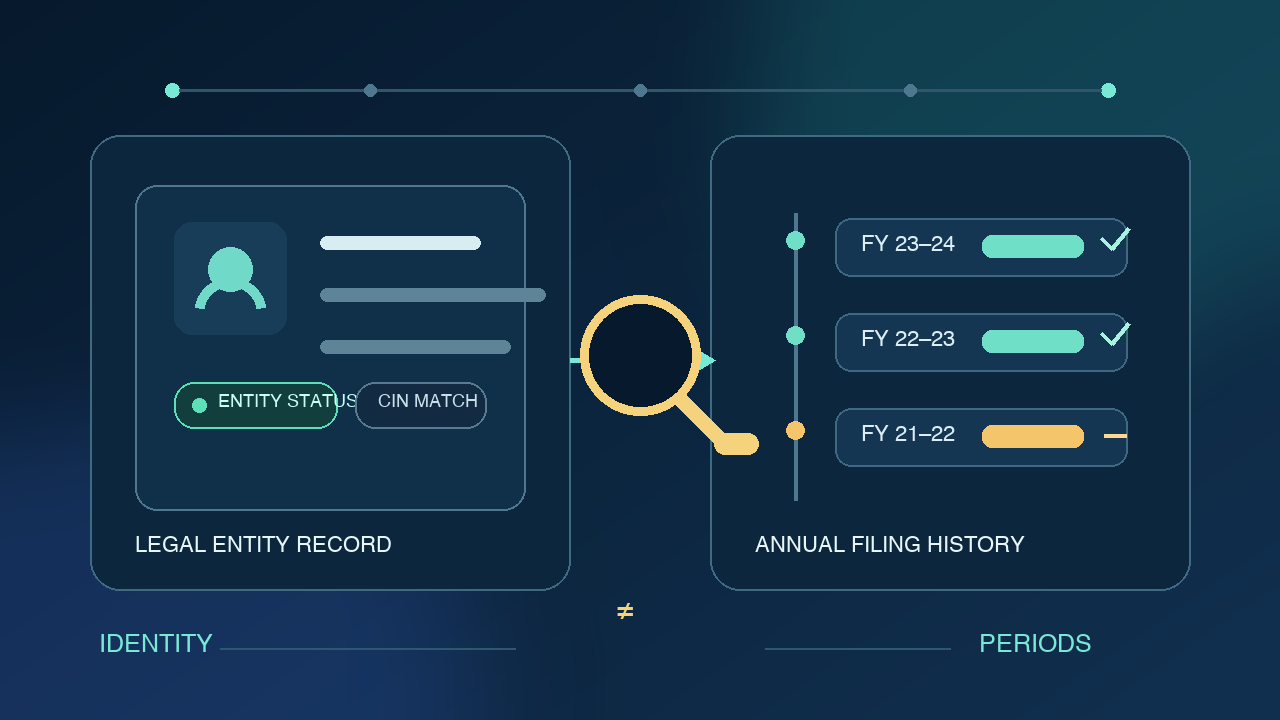
MCA company status and MCA annual filing status answer different questions. A company-status result identifies the registered entity and its current registry classification. Annual-filing records show whether particular returns or financial statements are recorded for particular financial years. Neither result should be silently expanded into a claim that the startup is fully compliant, currently trading, profitable, funded, safe, or government-approved.
For founders, researchers, procurement teams and editors, the practical method is to capture both checks separately: match the legal name and CIN first, record the displayed company status and check date, then record each available annual return and financial-statement filing by financial year. This is a public-record research workflow, not legal, accounting, tax, investment or compliance advice.
Why one green status is not the whole answer
The Ministry of Corporate Affairs exposes separate public surfaces for checking a Company or LLP name and checking annual filing status. That separation matters. The first search returns identity fields such as the name, corporate identifier and status. The second is designed around filing history.
The MCA's Corporate Data Management portal also presents company-status distributions separately from financial-statement and annual-return filing data. Treat those as related layers, not synonyms.
| Record layer | A bounded claim it can support | What it does not establish by itself |
|---|---|---|
| Company or LLP name search | A named legal entity and identifier appear with the displayed registry status when checked | Complete annual filing history, revenue, active customers, funding, tax compliance or product quality |
| Company master data | The displayed legal name, CIN, incorporation details, registered office fields and status at the time checked | That every field is current beyond its recorded source, or that the business is commercially active |
| Annual filing status | The portal records specified annual forms for specified financial years | That every other Companies Act obligation is complete, or that the contents are accurate in every respect |
| Filed document | The document and its filed particulars can be examined in context | Independent verification of every statement, a present-day valuation or an endorsement by MCA |
The safe editorial verb is usually “the MCA record showed,” followed by the exact field, financial year and date checked. Avoid “MCA verified the startup” or “fully MCA compliant” unless a qualified reviewer has defined and tested every obligation behind that broader claim.
Start with identity, not a brand name
A startup's public brand may differ from its incorporated name. Search the official MCA name service and capture the exact legal name plus Corporate Identity Number, or CIN. If several similar names appear, do not choose the closest-looking result from spelling alone.
Use the startup's own legal notice, invoice, terms page or founder submission only as an identity bridge. Then confirm that bridge against the official record. The separate source-first Indian startup verification workflow explains how to keep a brand, legal entity and public claim connected without pretending they are automatically identical.
Record at least:
- public brand and the source connecting it to the entity;
- exact legal name and CIN shown by MCA;
- previous name, if the search displays one;
- company status exactly as displayed;
- registered office state or jurisdiction fields relevant to the match;
- date, time and timezone of the check.
If the legal name or CIN conflicts across credible sources, stop. Do not proceed to filing analysis until the entity match is resolved.
Read company status as a registry field
Company status is useful because it distinguishes registry categories such as active, dormant, under a strike-off process, struck off, under liquidation or other displayed states. It is not a one-word due-diligence report.
The Companies Act, 2013 on India Code shows why the surrounding context matters. Section 248 gives the Registrar a process for removing a company's name on stated grounds, including specified non-operation conditions. Section 455 separately provides for dormant-company status and defines an inactive company for that section using business, transaction and filing conditions.
Those provisions create procedures and categories. A researcher should not reverse them into an unsupported conclusion such as “Active proves current operations” or “not struck off proves all filings are current.” Record the visible status, then investigate the separate evidence needed for the sentence you want to publish.
The current MCA homepage, checked on 14 September 2026, displays separate headline counts for active companies and company incorporations or strike-offs. Those changing dashboard figures are not needed to verify an individual startup, so they should not be copied into a company profile as entity-level proof.
Check annual returns and financial statements separately
The Companies Act creates distinct annual records. Section 92 describes the annual return and the particulars it covers as at the close of the financial year, including registered office, principal business activities, shareholding, members, promoters, directors and other prescribed disclosures. Section 137 separately requires financial statements and attached documents to be filed with the Registrar within the applicable framework.
MCA's current annual-filing FAQs likewise distinguish AOC-4 financial-statement filings from MGT-7 or MGT-7A annual returns and explain linked forms under the V3 workflow. A single recorded form is therefore not a substitute for checking the other relevant annual record.
Build one row per financial year:
| Financial year | Annual return | Financial statements | Filing date or SRN shown | Limitation |
|---|---|---|---|---|
| FY under review | MGT-7 or MGT-7A record, if displayed | AOC-4 variant, if displayed | Capture each separately | Portal availability is not a legal opinion on all obligations |
Do not merge the form date with the financial-year end. A filing made later can describe an earlier reporting period. Do not call the newest visible document “current financials” without naming the period it covers.
Filing presence is evidence, not a universal clearance
A recorded annual return can support facts actually contained in that return for its reporting date. A recorded financial statement can support the figures and disclosures it presents for its period, subject to the document's scope, audit context and later amendments. Filing presence alone does not independently prove that every statement is true, every liability is disclosed, every tax return is complete or every subsequent event is captured.
It also does not prove:
- DPIIT startup recognition or Udyam registration;
- GST, income-tax, labour, sector-licence or data-protection compliance;
- active customers, current revenue, profitability or solvency;
- current ownership of a brand, patent or website;
- a funding round, bank receipt, valuation or investor endorsement;
- product safety, cybersecurity or commercial quality.
Use the dedicated Udyam and DPIIT evidence guide for those separate government records. If the research involves many entities or reporting years, apply the reproducible startup dataset audit rather than copying portal rows into an undocumented spreadsheet.
A reproducible two-pass MCA check
Pass 1: establish the entity and current displayed status
- Write the exact claim you plan to publish.
- Search the legal name on the official MCA surface.
- Match the CIN, not only the brand or spelling.
- Capture the displayed status and the checked-at time.
- Save the official URL and a minimal research note without exposing personal data unnecessarily.
Pass 2: establish the filing history relevant to the claim
- Open the annual-filing status service for the matched entity.
- Select the exact financial years needed for the claim.
- Record annual-return and financial-statement forms separately.
- Capture reporting period, form type and filing date as separate fields.
- Inspect the underlying public document when the claim depends on its contents.
- Note missing, conflicting, amended or unavailable records instead of guessing.
Preserve the check as a dated evidence row. A screenshot can help document what was visible, but searchable identifiers and source URLs make the result reproducible. Never publish signatures, residential addresses, personal phone numbers or other unnecessary personal data merely because a public filing contains them.
Stop conditions for founders and researchers
Hold or narrow the claim when:
- a brand cannot be reliably connected to one legal entity;
- the CIN differs across the founder's materials and MCA;
- the portal shows a strike-off, dormant, liquidation or other material status that the draft omits;
- annual-return and financial-statement records cover different periods;
- the newest visible filing is older than the period implied by “current”;
- a search snippet conflicts with the official record;
- a filing is present but the document needed for the claim was not reviewed;
- the conclusion depends on private or sensitive data that should not be exposed;
- the question requires a legal, accounting, tax or investment conclusion.
In those cases, publish only the narrower verified fact, mark the field unresolved or seek qualified review. A missing public record is not proof that no filing exists, and an available record is not permission to overstate what it means.
A 12-point MCA evidence checklist
Before citing an Indian startup's company or filing status:
- Define the exact sentence and its evidence boundary.
- Match the brand to the legal entity with a documented bridge.
- Record the exact legal name and CIN.
- Capture company status exactly as displayed.
- Add the check date, time and timezone.
- Choose the financial years relevant to the claim.
- Record annual returns and financial statements separately.
- Keep reporting period, form type and filing date in separate fields.
- Review the filed document when relying on its contents.
- Note missing, amended, stale or conflicting records.
- Remove unnecessary personal data from public notes.
- Publish no conclusion broader than the weakest verified layer.
Researchers can use the SuperLaunch startup directory for discovery, then return to MCA and other issuing authorities for material claims. SuperLaunch's editorial policy explains its sourcing, corrections, privacy and commercial-separation rules.
The practical rule
Company status answers, “How is this entity classified in the registry when checked?” Annual filing status answers, “Which annual records are shown for which periods?” A filed document answers only the questions supported by its own contents and context.
Keep those layers in separate columns. Match the CIN, name the financial year, preserve the form type and date the check. That produces a useful, reproducible statement without turning one MCA field into a universal certificate of startup health or compliance.