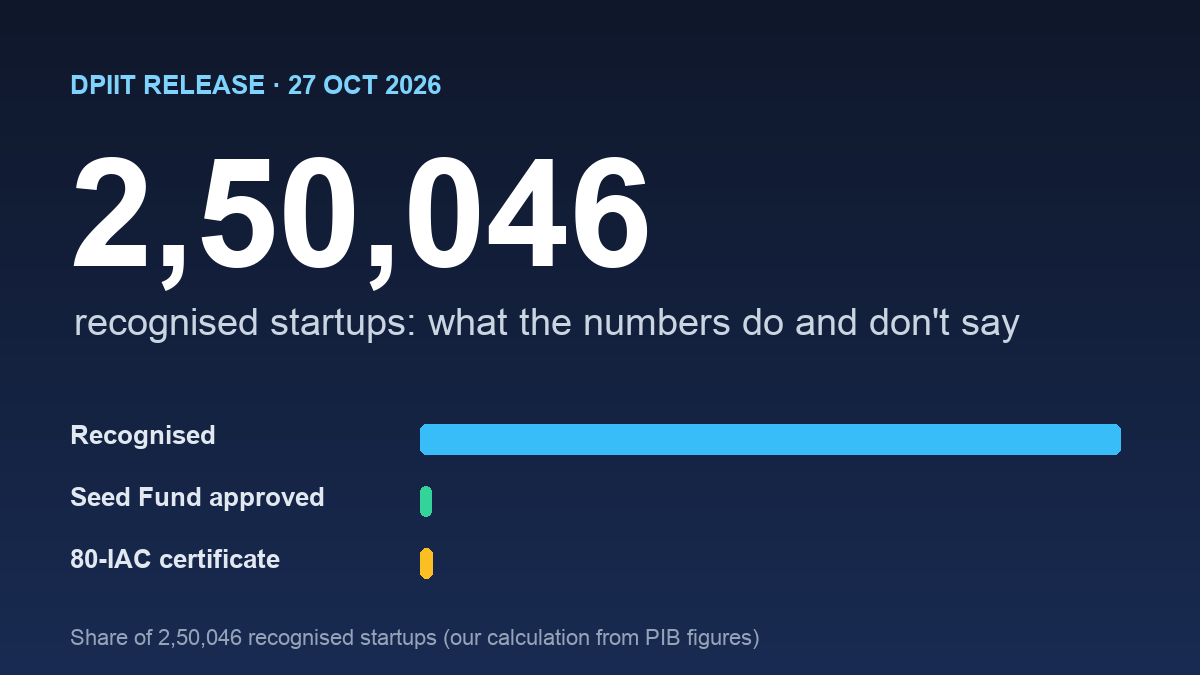
On 27 October 2026 the Press Information Bureau published a Department for Promotion of Industry and Internal Trade (DPIIT) release with a headline most Indian founders will have seen quoted: 2.5 lakh recognised startups and 25.42 lakh jobs. The release is full of figures, and they measure very different things. A recognition count is not a count of operating companies. A funding commitment is not money received. A "compliance reduced" total is not the same as compliances removed.
This guide reads the release line by line, keeps each number attached to what the release actually says it counts, and shows which ones are safe to quote on a pitch deck, a website or a directory profile. It is an explainer built on two sources we re-read on 1 November 2026: the PIB release (ID 2328842) and the Startup India recognition page. It is not legal, tax or funding advice. The arithmetic in the tables is ours and is labelled as such.
The short answer
DPIIT has recognised 2,50,046 startups, which tells you how many entities have received a recognition certificate, not how many are trading today. The 25.42 lakh jobs are described as "reported". Most other figures in the release are cumulative programme totals across years. If you quote any of them, quote the exact wording, the date of the release and the source link, and never turn a programme total into a claim about your own company.
What the release counts, number by number
| Figure in the release | What it counts | What it does not tell you |
|---|---|---|
| 2,50,046 recognised startups | Entities holding DPIIT recognition | How many are still operating, funded or profitable |
| 25.42 lakh+ jobs, 770+ districts, 56 industries | Jobs reported by those startups | How the jobs were reported, or how many are full-time |
| 52% non-metro, 48% with at least one woman director | Share of recognised startups | Share of jobs, revenue or funding |
| 34,200 (FY 2023-24) to 36,440 (FY 2024-25) | Annual recognitions | Anything about the current year |
| 4,467 holding Section 80-IAC certificates | Startups with the tax-holiday eligibility certificate | Whether any claimed the holiday in a given year |
Three of these are easy to over-read. The jobs figure is a headline total across a quarter of a million entities; dividing it by the startup count gives about 10 jobs per recognised startup, but that is our own average, and an average hides a long tail of one-person companies and a few large employers. Do not describe a typical Indian startup as having ten employees on the strength of it.
The annual recognition numbers rose by about 6.5 per cent between the two years the release gives (34,200 to 36,440, our calculation). The release does not give a figure for FY 2025-26, so any claim about this year's pace needs a different source.
The 80-IAC figure is a useful reminder of how narrow the benefits funnel is. Against the recognition total, 4,467 certificate holders is under 2 per cent (our calculation). The Startup India page explains why: only private limited companies and LLPs qualify, the company must have been incorporated after 1 April 2016, and recognition comes first.
Money: commitments, approvals and investments are different layers
The release lists several funding programmes, and each uses a different verb.
- Seed Fund Scheme: ₹775.67 crore has been approved for 4,194 startups across 32 States and UTs through 244 incubators. Approved is not disbursed. Our companion guide on approved seed funding versus cash received explains the tranche and bank-receipt steps that sit between approval and money in an account.
- Fund of Funds for Startups: SIDBI has committed ₹12,623 crore to 166 Alternative Investment Funds, which have invested ₹28,254 crore in 1,475 startups. Two different levels sit in one sentence: what the government-backed fund committed to AIFs, and what those AIFs then put into companies, and the release does not say whether the AIF figure includes money from other investors.
- Credit Guarantee Scheme: 532 loans worth ₹1,662.71 crore have been guaranteed, to startups employing 41,637 people. A guarantee is cover for a lender, not a grant, and the loan still has to be repaid. The release also says the cover per borrower doubled from ₹10 crore to ₹20 crore and the annual fee fell to 1% for 27 Champion Sectors.
- GeM: startups registered on the Government e-Marketplace grew from 7,929 in January 2021 to 43,260, and the release says they have delivered 6.23 lakh orders worth ₹68,105 crore to public buyers. That is a cumulative order value across all those startups, not a per-startup average and not a statement of profit.
Dividing the seed fund approvals by the approved startups gives roughly ₹18.5 lakh per startup (our calculation), but the release gives no per-startup breakdown, so that average should not be read as a typical cheque. Only 4,194 of the 2,50,046 recognised startups appear in the seed fund figure, about 1.7 per cent (our calculation), which is a sensible reality check when a pitch implies recognition leads to funding.
"47,957 compliances reduced" is four different actions
The release says 47,957 compliances have been reduced across Central ministries and States and UTs. It splits the figure: 22,290 digitised, 16,141 simplified, 5,255 decriminalised and 4,271 eliminated. These add up to the total.
For a founder, the split matters more than the total. About 46 per cent of the reductions are digitisation, which changes how you file and not whether you file. Only 4,271 were eliminated outright, about 9 per cent (our calculation). The release also reports that the Jan Vishwas Acts have decriminalised 900 provisions: 183 provisions across 42 Acts in 2023 and 717 provisions across 79 Acts in 2026. Decriminalised means the penalty changed from a criminal one; it does not mean the obligation went away.
Two other items in the release are concrete enough to act on. The National Single Window System (NSWS) says it has received 15,49,850 applications and registered 5,76,778 businesses, with 3,779 services live. Its Know Your Approvals module covers over 8,000 approvals so a business can see which Central and State approvals apply. Recognition itself is applied for through NSWS, according to the Startup India page.
What recognition requires today
The Startup India recognition page, which cites notification G.S.R. 108(E), gives the current criteria. The entity must be a private limited company, partnership firm, LLP or cooperative society. Turnover must be below ₹200 crore in any previous financial year (₹300 crore for DeepTech). An entity counts as a startup for up to 10 years from incorporation (20 for DeepTech). It must work towards innovation or improvement of products, services or processes, and an entity formed by splitting up or reconstructing an existing business does not qualify.
The same page says DPIIT has not appointed any agency or franchise for recognition certificates and does not charge a fee for them. If someone asks you to pay to "get your DPIIT number", that is outside what the page describes.
How to quote these numbers without overclaiming
- Quote the verb. "Recognised", "reported", "approved", "committed", "guaranteed" and "reduced" are not interchangeable. Copy the release's word.
- Date it. Write "as of the PIB release of 27 October 2026". These totals change.
- Keep programme totals out of company claims. A line such as "India has 2.5 lakh recognised startups" is a fact about the ecosystem. "We are one of India's 2.5 lakh funded startups" is not supported by anything in the release.
- Show your own record. If you are recognised, cite your certificate and check date. Our guide to what Udyam and DPIIT recognition each prove lists where each record can be verified and which claims neither supports.
- Link the source. Point to the PIB release and the Startup India page so readers can see the original wording.
Where this leaves a founder
The release is a reasonable snapshot of how government programmes describe themselves, and several figures, such as the 52 per cent non-metro share, say something real about where recognised startups are located. But it is a summary of programme activity written by the department that runs the programmes. Use it to understand the landscape, check your own eligibility on the Startup India page, and treat any number you want to repeat as a claim that needs its exact wording and a date. If you are preparing a public profile for your own startup, our startup directory submission checklist shows which evidence to gather first.
Sources
- Press Information Bureau, Ministry of Commerce and Industry, "DPIIT Advances Trust-Based Governance Through Startup Support, Regulatory Reforms and Digital Single-Window Clearances", Release ID 2328842, posted 27 October 2026: pib.gov.in.
- Startup India, "DPIIT Startup Recognition & Tax Exemption" (eligibility criteria, G.S.R. 108(E), 80-IAC conditions, no-agency and no-fee disclaimer): startupindia.gov.in.