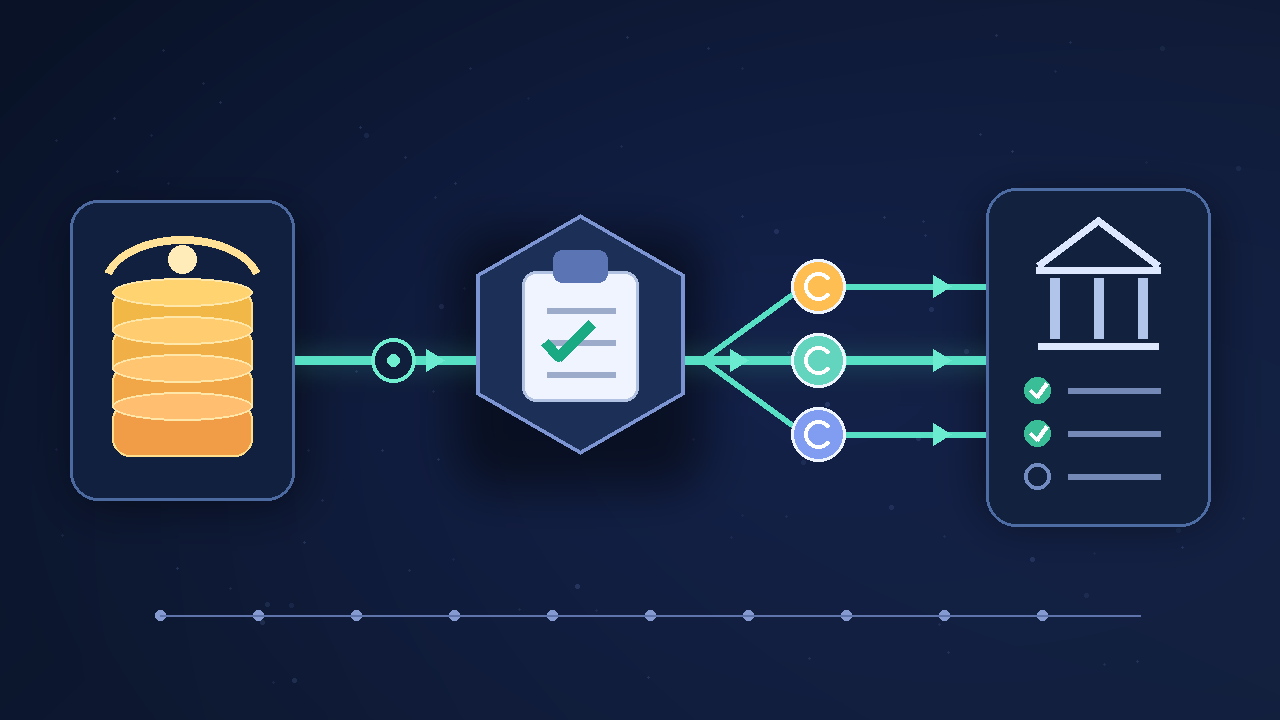
Under the Startup India Seed Fund Scheme, an approved amount is not automatically cash received. Approval records a decision to support a startup on stated terms. The startup and incubator still need the required agreement, and grant money is released in milestone-based instalments. Later instalments depend on progress evidence and a utilisation certificate. A founder, researcher or editor should therefore report the exact stage shown by the source: applied, selected, approved, agreed, disbursed, or received.
This distinction matters because each word answers a different financial question. It is inaccurate to turn a scheme corpus, incubator allocation or approved amount into ‘funding received’ without evidence of release and receipt. This guide is for research and public wording, not financial, legal, tax or eligibility advice. Scheme rules and individual agreements can change, so verify the current official pages and the startup's own documents before acting.
The funding claim has six separate stages
A clean evidence trail treats SISFS support as a sequence rather than one event. The Startup India Seed Fund Scheme overview says the scheme has a ₹945 crore outlay and that seed funds are disbursed to eligible startups through eligible incubators. That describes the scheme's design; it does not mean every rupee is already in a startup bank account.
| Stage | What the evidence can support | What it does not prove |
|---|---|---|
| Scheme outlay or corpus | Money authorised or set aside for the programme as described by the official source | Allocation to a named incubator or startup |
| Incubator allocation | The scheme has allotted funds to an eligible incubator | Selection, approval or payment to a particular startup |
| Startup selection | An incubator's committee selected a startup for support | Final terms, signed agreement or money received |
| Funding approval | An amount and instrument were approved for the startup | Full disbursement or unrestricted cash |
| Tranche disbursement | A stated instalment was released under the agreement | Receipt of every approved instalment |
| Bank receipt | The startup's bank evidence shows credited funds | Completion of later milestones or release of the balance |
Do not collapse these stages into a single ‘funded’ label. If the available record stops at approval, the public sentence should stop there too.
Why official wording must be preserved
A 17 March 2026 Press Information Bureau release says that, as of 31 January 2026, selected incubators under SISFS had approved funding of around ₹592 crore to selected startups. The release's annexure is also labelled as funds approved by selected incubators. It does not relabel that number as cash received by startups.
That verb is part of the evidence. A report may accurately say, ‘PIB reported around ₹592 crore approved under SISFS as of 31 January 2026.’ It should not say, ‘Startups received ₹592 crore,’ unless a source measuring disbursement or receipt supports that statement at the same cut-off date and scope.
The original 5 February 2021 PIB scheme announcement describes the ₹945 crore corpus and the intention to provide seed funding through incubators. A programme-level corpus and a later approval total are different measures. Subtracting one from the other and calling the result ‘unused cash’ would also be unsafe without the scheme's allocation, drawdown, return and timing data.
Grant and debt support are not interchangeable
The current SISFS frequently asked questions, checked on 10 September 2026, describe two funding routes for eligible startups:
- up to ₹20 lakh as a grant for proof-of-concept validation, prototype development or product trials, released in milestone-based instalments;
- up to ₹50 lakh for market entry, commercialisation or scaling through convertible debentures, debt or debt-linked instruments.
These are ceilings, not automatic entitlements. ‘Eligible for up to ₹20 lakh’ does not mean ‘awarded ₹20 lakh,’ and an approval does not prove that the full amount was disbursed. The instrument must also be named. A grant should not be described as debt, while debt or a convertible debenture should not be presented as non-repayable grant money.
The official scheme guidelines establish the programme framework, while the FAQ says the quantum, terms and milestones are documented through the incubator process and agreement. For a specific startup, the signed agreement and transaction evidence are stronger than a generic scheme summary.
‘Selected’ is still not ‘paid’
The FAQ says the Incubator Seed Management Committee evaluates and selects startups. It separately says the incubator must execute a legal agreement with a selected startup before the first instalment is released. That separation creates a clear reporting boundary.
A selection email can support ‘selected for SISFS assistance by the named incubator,’ subject to authenticity and current status. It cannot by itself support ‘received government funding.’ Before publishing the stronger claim, identify the approved instrument and amount, confirm the agreement stage, and inspect evidence for the actual transfer.
One tranche does not prove the full amount
For grants, the FAQ says later instalments require an interim progress update and utilisation certificate. A first credit therefore supports receipt of that tranche, not receipt of the full approved amount.
Use cumulative wording only after adding verified credits from the same agreement and excluding reversals or returned funds. If a startup has an approval for ₹20 lakh and one verified ₹5 lakh credit, the evidence supports ‘₹5 lakh received against a ₹20 lakh approval,’ not ‘₹20 lakh raised.’
A source ladder for a named startup
Start with the exact sentence you want to publish. Then collect evidence from the lowest stage upward.
1. Identify the scheme and intermediary
Confirm that the record refers to SISFS and name the incubator involved. Do not infer SISFS support from generic phrases such as ‘government-backed,’ ‘incubated,’ or ‘seed supported.’ An incubator may run several programmes with different funders and terms.
2. Match the startup's legal identity
Match the entity name on the approval or agreement to the startup being discussed. A public brand and legal entity can differ. Use the source-first Indian startup verification workflow when identity needs reconciliation, and hold the funding claim if the bridge is missing.
3. Record the decision evidence
Capture the selection or approval date, approved amount, instrument, incubator, and any stated conditions. Keep confidential agreements and bank material private. Public reporting usually needs the evidence result and scope, not account numbers, signatures or personal identifiers.
4. Verify each disbursement separately
For every claimed receipt, record the transaction date, credited amount, payer, beneficiary entity and agreement reference in a protected evidence file. Reconcile the sum to the public wording. An invoice, sanction letter or expected-payment schedule is not bank receipt evidence.
5. Add an ‘as of’ date and limitation
Funding records are snapshots. Write, for example: ‘The company provided evidence of ₹5 lakh received under its SISFS grant as of 10 September 2026; the remaining approved amount was not verified as disbursed.’ This is less dramatic than ‘government-funded startup,’ but it is auditable.
An evidence register that prevents inflation
Use one row per milestone rather than one row per startup.
| Field | What to record |
|---|---|
| Claim | Exact sentence proposed for publication |
| Scheme | SISFS, not a generic ‘startup fund’ label |
| Incubator | Full name of the disbursing intermediary |
| Stage | Applied, selected, approved, agreed, disbursed or received |
| Instrument | Grant, debt, convertible debenture or debt-linked instrument |
| Amount | Ceiling, approved amount, tranche or cumulative receipt |
| Evidence date | Date on the document or transaction |
| Checked at | Research date, time and timezone |
| Evidence owner | DPIIT, incubator, startup or bank record |
| Limitation | What the record does not establish |
Keep programme statistics in a separate table from company-level records. A national approval total cannot confirm one startup's receipt, and one startup's bank credit cannot validate a national total. For aggregate analysis, apply the separate reproducible startup dataset audit.
Stop conditions for editors and researchers
Do not publish ‘received funding’ when:
- the only source is a scheme corpus or programme announcement;
- the startup shows an application, shortlist or selection but no approval terms;
- an approval letter exists but no disbursement evidence is available;
- the credited entity does not match the startup or lacks a documented bridge;
- the amount mixes grant and debt without naming the instruments;
- one tranche is presented as the complete approved amount;
- the evidence is a cropped screenshot with no verifiable date, issuer or context;
- confidential bank or agreement details would need to be exposed to make the claim;
- two credible records conflict on amount, stage or date.
In those cases, either publish the narrower verified stage or mark the claim unverified. Do not fill the gap with a founder quote, another directory or arithmetic based on unrelated totals.
A 12-point SISFS funding-claim checklist
Before publishing a founder profile, funding database row, pitch-deck fact or article:
- Name SISFS and the relevant incubator.
- Match the startup's legal entity to the record.
- Separate scheme corpus from incubator allocation.
- Separate selection from approval.
- Separate approval from signed agreement.
- Separate each disbursed tranche from the total approved amount.
- Name the instrument: grant, debt, convertible debenture or debt-linked support.
- Distinguish a maximum ceiling from the actual approved amount.
- Reconcile claimed receipts to protected transaction evidence.
- Add the source date and the date you checked it.
- State the strongest wording the evidence supports, no stronger.
- Hold the claim if identity, amount, instrument or stage conflicts.
Founders can use the startup directory submission checklist to prepare public facts before review. Researchers can browse the Indian startup directory for discovery, then return to issuing sources for financial claims. SuperLaunch's editorial policy explains its sourcing, correction and commercial-separation boundaries.
The practical rule
A corpus is programme capacity. An allocation moves capacity to an intermediary. Selection identifies a startup. Approval records a decision and terms. Disbursement releases a tranche. Receipt shows money credited. None of those words is a synonym for all the others.
Preserve the official verb, name the instrument, match the entity, and date the evidence. If you can prove only approval, say approved. If you can prove one credited tranche, report that tranche. Accurate funding language is not a technicality; it is the difference between a traceable fact and an inflated claim.
Sources checked on 10 September 2026
- Startup India Seed Fund Scheme: overview, objectives and eligibility
- Startup India Seed Fund Scheme: current frequently asked questions
- DPIIT: Guidelines for Startup India Seed Fund Scheme
- Press Information Bureau: Startup India Seed Fund Scheme announcement, 5 February 2021
- Press Information Bureau: approved SISFS funding as of 31 January 2026, published 17 March 2026