If you sell software or services in India, UPI has probably been the payment method you never had to price in. Since 15 October 2026 that is no longer fully true. A Merchant Discount Rate (MDR) of 0.4 percent now applies to a defined slice of UPI payments made to businesses, and the rest stay free. Founders keep asking the same thing: does this touch my checkout, and what do I change?
This guide sets out what the rule says, what it costs on real order values, which payments are exempt, and what to check in your own gateway agreement. It is an explainer built from the Department of Financial Services FAQ and news reports, not legal, tax or accounting advice, and we re-checked the figures on 30 October 2026.
The short answer
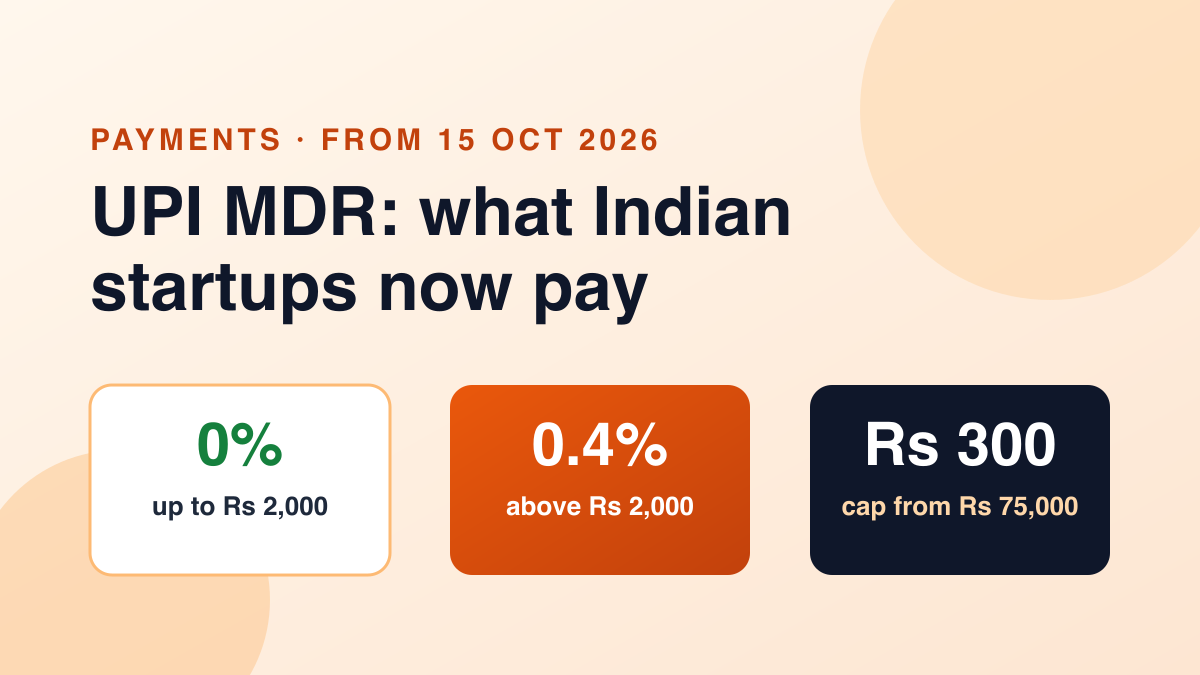
From 15 October 2026, a 0.4 percent MDR applies to person-to-merchant (P2M) UPI payments above ₹2,000, and the fee is capped at ₹300 per transaction for payments of ₹75,000 and above. Payments up to ₹2,000 carry no MDR. Person-to-person transfers remain free, and the customer pays nothing in any case. The fee falls on the merchant, which in your case means your business, collected through whoever acquires your payments.
What the rule actually says
The Department of Financial Services (Ministry of Finance) published an FAQ on this MDR dated 15 September 2026. These are the points that matter for a startup:
- Rate. 0.4 percent on P2M UPI transactions above ₹2,000, capped at ₹300 per transaction from ₹75,000 upwards.
- Flat-fee sectors. For railways, telecom, insurance, fuel and some other categories, a flat ₹5 per transaction applies above ₹2,000. Public utilities are in the same group.
- Capital markets. Payments to mutual funds, securities and stockbrokers carry 0.02 percent, also capped at ₹300.
- Who decides. The operating parameters are set by the UPI steering committee headed by NPCI.
- Consumers. The FAQ says consumers are not charged, P2P transfers stay free, and UPI apps may not levy a platform fee on UPI payments.
- No pass-through. Merchants cannot pass the MDR on to customers; customers pay the listed price.
The FAQ also says transactions up to ₹2,000 make up more than 95 percent of P2M UPI volume. That is why most everyday payments are unaffected, and why the impact on a founder depends almost entirely on your average order value.
What it costs on real order values
The FAQ gives its own worked examples, and the same arithmetic applies to typical software prices.
| Payment | MDR applied | Fee you pay |
|---|---|---|
| ₹1,999 | None (up to ₹2,000) | ₹0 |
| ₹3,000 | 0.4% | ₹12 |
| ₹19,990 | 0.4% | about ₹80 |
| ₹50,000 | 0.4% | ₹200 |
| ₹1,00,000 | 0.4% would be ₹400, capped | ₹300 |
Read the table by payment, not by month. A customer who pays ₹1,999 every month never triggers the fee, while the same customer paying ₹19,990 for an annual plan triggers it once. The fee is small next to the 1.5 to 2.5 percent the FAQ cites for standard credit card MDR, or the debit card ceiling of 0.90 percent, but on a thin-margin product the difference between ₹0 and ₹80 per sale is real. Whether your payment gateway adds its own charges on top is set by your agreement, not by this rule.
Which of your payments are exempt
Not every UPI rupee you receive is a P2M payment above the line. The FAQ and the news coverage set out several carve-outs:
- Small merchants under the P2PM framework. Merchants receiving up to ₹1 lakh a month through UPI QR directly into their account stay at zero MDR, without needing a GST registration. A merchant whose inward UPI credits exceed ₹1 lakh a month for three consecutive months moves to the standard P2M category.
- AutoPay and UPI Mandates. The FAQ says recurring standing instructions, such as subscriptions and utility bills, do not carry a prescribed MDR. If your product bills monthly through UPI AutoPay, this is the most relevant line for you.
- Credit-linked UPI. RuPay credit cards linked to UPI and pre-sanctioned credit lines follow separate credit product rules, not this MDR.
- Payments up to ₹2,000. Zero MDR, and according to the government statement reported by IANS, no GST arising from MDR either.
A practical point: an exemption that depends on your account category is something your acquiring bank or payment aggregator applies, not something you can claim at checkout. Ask them which category your account sits in.
Why this is happening
The FAQ argues that UPI processes billions of transactions every month and that the fee funds infrastructure resilience, security and customer service. It also cites an industry estimate of roughly ₹20,000 crore a year to run UPI and says government incentives were meant as short-term bridge funding. NPCI data reported by IANS puts September 2026 at 24.07 billion transactions worth ₹29.37 lakh crore, after 24.51 billion in August.
Not everyone accepts the reasoning. Al Jazeera reported that analysts estimated an annual revenue pool of about ₹17,000 crore, split roughly 60 percent to banks, 25 percent to app providers and 15 percent to aggregators, and that retailers' groups and the opposition criticised the move. Traders' bodies had called for a "No UPI Day" on 2 October, then withdrew the call after meeting the Finance Minister. The same report found at least one shop already adding its own fee for larger UPI payments despite the no-pass-through rule. Treat the policy as settled for now but still moving: the FAQ says the framework for a dedicated small-merchant fund will be finalised with the RBI within three months of 15 September.
What to do this week
You do not need a rebuild. You need five checks.
- Pull your last 30 days of UPI orders and split them at ₹2,000. The share above the line tells you your exposure.
- Read your payment gateway or aggregator statement for the first settlements after 15 October. Confirm whether an MDR line appears, at what rate, and whether GST is charged on it. Ask your chartered accountant how to book it.
- Check your pricing tiers. If an annual or high-value plan sits just above ₹2,000, you now pay a small percentage there that monthly payments avoid. Do not respond by adding a "UPI fee" at checkout, because the framework says merchants cannot pass the MDR to customers. Change your list prices only if the margin needs it.
- Confirm how subscriptions are collected. If you bill through UPI AutoPay, ask your provider in writing whether any MDR applies to those debits.
- Update your finance model. Add a 0.4 percent line for UPI above ₹2,000 next to your card and net-banking costs, and cap it at ₹300 for large invoices.
For the mechanics behind these fees, our guide to how a payment gateway works in India explains who sits between your customer and your bank account. If you are still choosing a provider, see the Razorpay integration guide for SaaS, and for the pricing side read our SaaS pricing guide for India.
For background on the question itself, there is a video interview titled If UPI Is Free, Who Pays for It? by Nikhil Kamath on YouTube. We cite it as further viewing, and nothing in this article relies on it.
Frequently asked questions
Do customers pay anything extra to pay me by UPI?
No. The FAQ says consumers are not charged, P2P transfers stay free, and UPI apps cannot levy a platform fee. The MDR is a merchant-side fee.
Is a payment of exactly ₹2,000 charged?
No. The FAQ's own table shows ₹2,000 at zero. The 0.4 percent applies to payments above ₹2,000.
Does the fee apply to refunds or failed payments?
The FAQ does not address refunds, so we cannot say. Ask your gateway how it treats the MDR on a refunded payment before you assume it is returned.
Is the MDR the same as a gateway fee?
No. The MDR is the UPI ecosystem rate set under the framework. Your gateway or aggregator may charge its own fee as well, under your contract. Read both lines on your pricing page.
Sources checked on 30 October 2026
- Department of Financial Services: FAQs on Merchant Discount Rate (MDR) on Select UPI (P2M) Transactions, 15 September 2026
- DD India (IANS): UPI transactions surge 23% to 24.07 billion in September: NPCI, 1 October 2026
- Al Jazeera: India to impose controversial fee for UPI instant payments: Who benefits?, 17 September 2026
When your startup is ready for customers, you can list it on SuperLaunch and browse the startup perks directory for tools that help with launch costs.