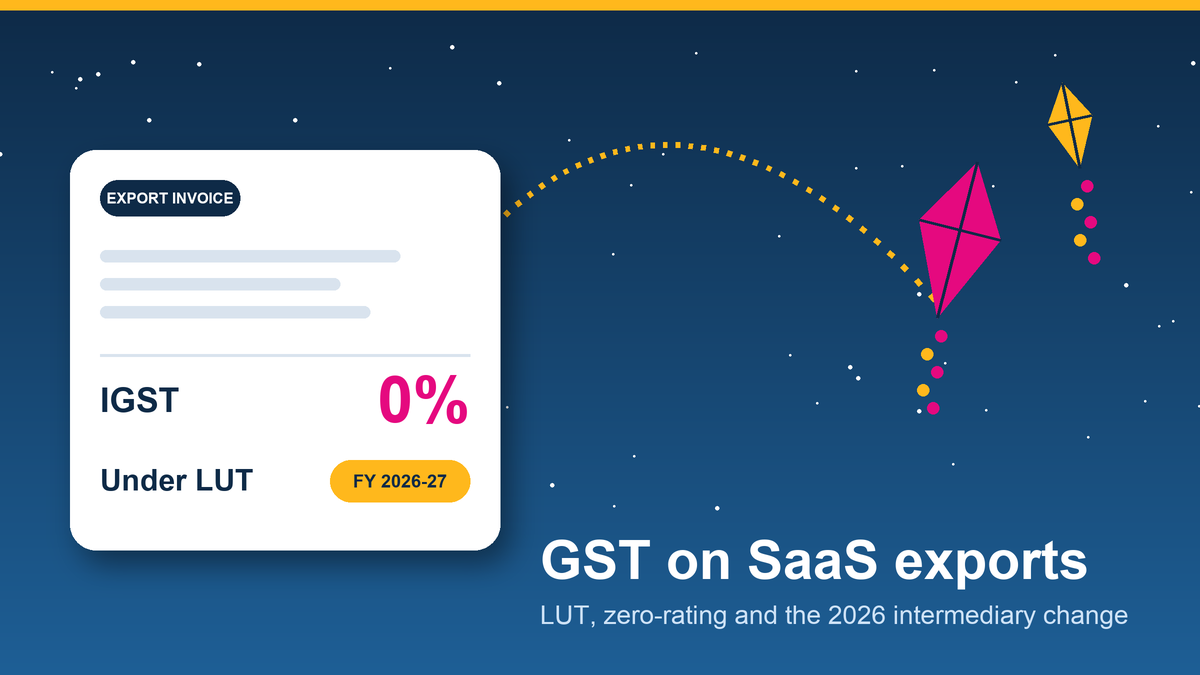
If you sell software to customers outside India, three things decide whether your invoice carries GST: the statutory test for an "export of services", a Letter of Undertaking (LUT) filed before you invoice, and, since the Finance Act, 2026, where the law puts the place of supply when your work is arranging a sale for someone else. Founders usually know the first idea ("exports are zero-rated") and miss the other two.
This is an explainer, not tax advice. It is built from the IGST Act text on CBIC's tax information site, the GST portal's own LUT FAQ, CBIC CBIC Circular 161/17/2021-GST and published commentary on the 2026 amendment. We re-read them on 3 November 2026, and your chartered accountant has the last word on your facts.
The short answer
A supply that meets the definition of "export of services" is a zero-rated supply under section 16 of the IGST Act. Zero-rated is not the same as exempt. The Act lets you take input tax credit for inputs used to make zero-rated supplies, and it lets a registered person claim a refund of unutilised credit when the supply is made without paying integrated tax under a bond or Letter of Undertaking, in line with section 54 of the CGST Act.
So the practical sequence for a SaaS company is: confirm all five conditions, file the LUT for the financial year before the first export invoice, invoice without IGST, and keep the evidence that the money arrived.
The five conditions in section 2(6)
The definition on CBIC's page for section 2 of the IGST Act lists five tests. All five must hold.
| # | Condition in the Act | What it means for a SaaS founder |
|---|---|---|
| i | The supplier of service is located in India | Your company, or its fixed establishment, is in India |
| ii | The recipient of service is located outside India | Your customer is the one located abroad, not just your end user's billing address |
| iii | The place of supply is outside India | Under section 13(2), the general rule is the recipient's location |
| iv | Payment has been received in convertible foreign exchange, or in Indian rupees where the Reserve Bank of India permits it | The wording is "has been received", so unpaid invoices are a risk |
| v | Supplier and recipient are not merely establishments of a distinct person under Explanation 1 to section 8 | You are not just a branch serving your own foreign head office |
Condition (v) has an official clarification. Circular 161/17/2021-GST, dated 20 September 2021, says a branch, agency or representational office of a foreign company in India that serves the same foreign company abroad is supplying between establishments of a distinct person, so that is not an export of services. It also says the opposite for subsidiaries. A company incorporated in India and a foreign company are separate persons under the CGST Act, so an Indian subsidiary or group company serving its foreign parent is not "merely an establishment" of that parent. For a founder with a US or UAE entity as the customer, the legal form of your India entity therefore matters: a separately incorporated company passes condition (v), a mere India branch does not.
The LUT: what the GST portal actually requires
The GST portal's LUT FAQ is short and specific.
- Who files. Any registered person who wants to supply for export without paying integrated tax must furnish a LUT before the supply, if they have not been prosecuted for tax evasion of Rs 2.5 crore or more.
- Where. On the GST portal under Services, User Services, Furnish Letter of Undertaking, using Form GST RFD-11.
- What you enter. The financial year, and the name, address and occupation of two independent witnesses. You tick the self-declarations.
- Who signs. An authorised signatory, using DSC or EVC.
- What you get back. An ARN and an acknowledgement. The status can read Submitted, Pending for Clarification, Approved, Rejected or Deemed Approved. Deemed Approved applies if the tax official takes no action within 3 working days.
- When it ends. The status changes to Expired at the end of the financial year. A LUT is per year, not forever.
Two things follow. First, the day to check is the first working day of April, not the day a big foreign invoice is due. Second, a tax official can disable LUT filing for a taxpayer, and the taxpayer cannot ask for it to be re-enabled from the portal; the request has to go to the LUT processing officer manually. If you are mid-year, as we are in November 2026, open the portal and confirm the 2026-27 LUT shows Approved or Deemed Approved.
What changed in 2026: intermediary services
For years, an Indian company that arranged sales between a foreign principal and customers, an agent, broker or commission-based sales-support arm, fell under section 13(8)(b) of the IGST Act. That clause put the place of supply at the supplier's location, in India, so GST applied even when the client sat abroad.
Section 157 of the Finance Act, 2026 omitted that clause. Commentary links the change to the GST Council's 56th meeting on 3 September 2025. After the omission, intermediary services fall under the general rule in section 13(2): the place of supply is the recipient's location. If the recipient is outside India and the other conditions are met, the service can now be zero-rated.
Commentators disagree on the start date. A TaxGuru analysis reads the omission as effective on 30 March 2026, the date of Presidential assent, because section 157 is not in the Act's list of provisions starting on 1 April 2026. A Rödl note states 1 April 2026. If you issued invoices in that window, ask your adviser which date they apply.
Who is an intermediary is still a question of facts. Section 2(13) covers a person who arranges or facilitates a supply between two or more persons but not one who supplies on their own account. A founder who sells their own SaaS subscription under their own contract is a principal supplier, not an intermediary. An agency that earns a commission for bringing a foreign vendor's customers to that vendor is the case the amendment addresses.
The flip side matters too. Rödl notes that Indian businesses receiving services from an overseas intermediary may now owe GST under reverse charge, with extra reporting and documentation.
Common mistakes
Filing the LUT after the first export invoice. The portal FAQ says to furnish it before the supply. Do not backfill and hope.
Treating zero-rated as exempt. Zero-rating is what keeps your input tax credit and the refund route available. Do not book export sales as exempt without checking with your CA.
Assuming a foreign address is enough. Conditions (ii), (iii) and (v) together test where the recipient is, where the place of supply falls, and whether the customer is just another establishment of your own company, such as a foreign branch.
Ignoring the payment condition. Condition (iv) is about how the payment has been received. Keep the bank's inward remittance advice or equivalent record against every invoice, and ask your bank or CA what applies when payment comes through a card network or a payment aggregator.
Letting the LUT lapse on 31 March. The status moves to Expired at year end. File the new one at the start of the new financial year.
Calling every partner arrangement "intermediary". The label depends on whether you supply on your own account. Document the contract structure.
A checklist before your next export invoice
- Open the GST portal and confirm the current financial year's LUT is Approved or Deemed Approved.
- Check each foreign customer: located outside India, and the contracting party is a separate company, not your own branch or office.
- Check how the payment will arrive and keep the remittance record.
- Mark export invoices as supplied under LUT without payment of IGST, as your accountant advises.
- Reconcile input tax credit and decide, with your CA, when to claim a refund of unutilised credit.
- If you earn commission for arranging sales, record whether you are an intermediary and which date your adviser applies.
What we did not verify
We did not review the registration threshold for service suppliers, refund filing limits, state-level requirements, the exact rules for rupee payments permitted by the RBI, or what to do if you invoiced an export without a LUT. Each of those depends on facts and dates that need a professional read.
For related reading, see how to check a startup's GST legal and trade name, how a payment gateway works in India and pricing your first SaaS product for India.