Many Indian founders write "ESOP pool 10%" into a term sheet or offer letter without being sure what happens next. When do options become shares? Who sets the price? When is tax due, and can it fall due before the company exits? Three things do most of the work: the Companies Act, the Income-tax Act and your own plan document.
This guide walks through how an employee stock option plan works for a private company in India, from the shareholder resolution to the tax bill. The tax and company-law points were re-checked on 29 October 2026 against the Income Tax Department's ESOP page, which reflects the Income-tax Act, 1961 as amended by the Finance Act, 2026, and the text of Rule 12 of the Companies (Share Capital and Debentures) Rules, 2014. This is an explainer, not legal or tax advice: have a chartered accountant or company secretary check your own plan.
The short answer
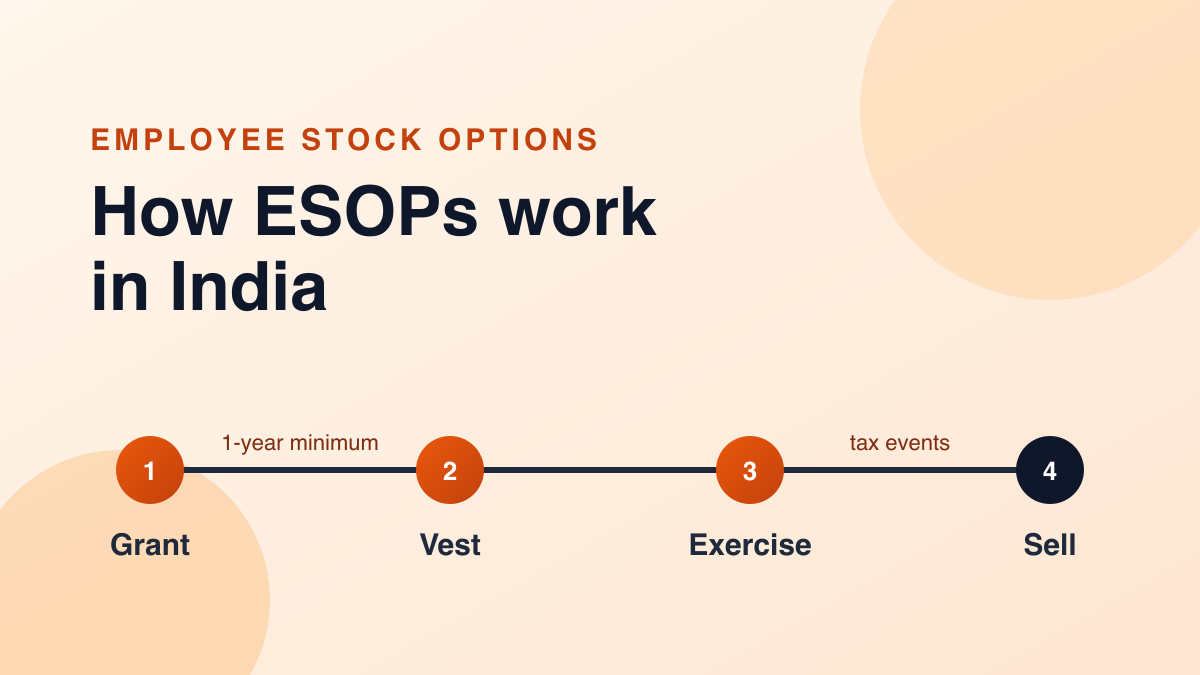
An ESOP gives an employee the right, but not the obligation, to buy shares in the company at a fixed price in future. The employee earns that right over time (vesting), then chooses whether to pay the exercise price and receive shares (exercise). Tax usually arises twice: once when the shares are allotted, as a salary perquisite, and again when the employee sells them, as capital gains. Eligible DPIIT-recognised startups get a deferral on the first tax event, which is the single most useful rule for an early-stage team.
Four words you need
| Term | What it means |
|---|---|
| Grant | The company offers the employee options at a set exercise price under the plan |
| Vesting | The employee earns the right to exercise, usually in stages as they stay with the company |
| Exercise | The employee pays the exercise price and the company allots shares |
| Sale | The employee later sells the shares, normally at a funding round, buyback or exit |
What company law requires
ESOPs for employees of a company sit under section 62(1)(b) of the Companies Act, 2013 and Rule 12 of the Share Capital and Debentures Rules. The rule sets a handful of requirements that founders often discover late:
- Shareholder approval. The scheme has to be approved by shareholders through a special resolution, with an explanatory statement disclosing details such as the total number of options, who is eligible and the vesting terms.
- Separate approval in two cases. A separate resolution is needed for grants to employees of a subsidiary or holding company, and for grants to identified employees who receive options equal to or exceeding one percent of issued capital in any one year.
- A minimum one-year gap. There must be at least one year between the grant of options and their vesting. You cannot grant an option today and let it vest next week. A four-year schedule with a one-year cliff is common, but that is convention, not law.
- Price freedom. The company can set the exercise price, in line with applicable accounting policies. The Rule also gives the company freedom to set a lock-in on the shares issued after exercise.
- No shareholder rights yet. An option holder has no dividend or voting rights until shares are actually issued on exercise.
- A register. The company must record grants in the statutory Register of Employee Stock Options (Form SH-6).
Who counts as an "employee"? Under the Rule, it covers permanent employees working in India or abroad and directors, whole-time or not, but it excludes independent directors, and by default excludes a promoter or anyone who, directly or through a relative or body corporate, holds more than ten percent of the outstanding equity. That default matters for founders, who often hold far more than ten percent.
There is a startup-specific relief. The Rule says the ten percent restriction does not apply to a startup company as defined in the DPIIT's notification of 19 February 2019, up to ten years from its incorporation or registration. If you are a DPIIT-recognised startup, founder-directors can therefore be granted options within that window. Our guide to Udyam versus DPIIT recognition explains what the DPIIT status does and does not prove.
How vesting works in practice
Vesting turns a grant into something exercisable. A typical plan might grant an employee 4,000 options that vest over four years, with the first slice after one year (the cliff) and the rest monthly or quarterly. Founders mostly choose between three levers:
- The length of the schedule. Your plan decides, subject to the one-year minimum.
- The cliff. A one-year cliff protects you from someone who leaves in month three with a stake.
- What happens on exit. Your plan should say what happens to unvested and vested options on resignation, termination, death, disability or a sale of the company. Ambiguity here is where most employee disputes begin.
Write these terms in plain language in the grant letter, not just in the plan.
Tax: two events, not one
The Income Tax Department's ESOP page sets out the structure clearly.
When shares are allotted. The difference between the fair market value of the shares on the date the option is exercised and the price the employee paid is taxed as a perquisite under salary. The value on the date of grant does not matter for this calculation. For unlisted shares, the fair market value is the value determined by a merchant banker, on the exercise date or on an earlier date that is no more than 180 days before the exercise.
When shares are sold. Gains are taxed as capital gains. The holding period runs from the date of allotment, not the date of exercise, and the fair market value on the exercise date is taken as the cost of acquisition, so the same gain is not taxed twice.
The department's worked example is useful. An employee at an eligible startup is allotted 100,000 shares at ₹10 each, and the fair market value at exercise is ₹100. The perquisite is 100,000 × (₹100 − ₹10) = ₹90 lakh. For an ordinary company, tax on that amount is deducted from salary in the year of allotment, which can be a heavy cash burden on someone who holds illiquid shares.
The startup deferral
For employees of an eligible startup, referred to in the Act by reference to section 80-IAC, the tax is deferred. The employer deducts the tax within 14 days of whichever of these happens first:
- 48 months from the end of the assessment year in which the shares were allotted;
- the date the person stops being an employee; or
- the date the shares are sold.
The employee still reports the perquisite in the return for the allotment year, but does not have to pay the tax on it that year. Tax is calculated at the rates in force for the financial year in which the securities were allotted or transferred.
Two cautions. First, DPIIT recognition on its own is the starting point, not the whole test: the deferral is tied to being an "eligible start-up" under section 80-IAC, so confirm every condition with your accountant before you promise it in an offer letter. Second, the Income-tax Act, 2025 replaces the 1961 Act from 1 April 2026 and renumbers provisions, so the section numbers you read in older articles may differ in current filings. Ask your adviser which numbering and wording applies to your year of allotment.
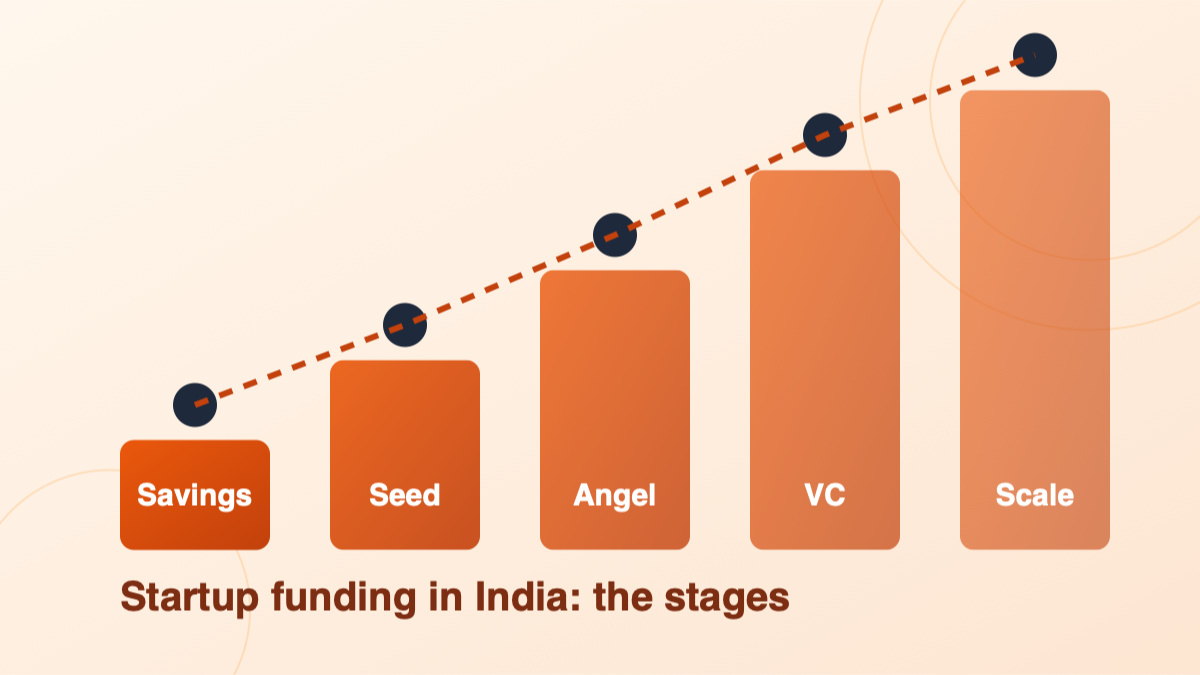
For the wider picture of how equity fits into raising money, see how startup funding works in India and our guide to what Indian angel investors look for.
Setting up a plan: a founder's checklist
- Decide the pool size and who it is for. Investors often ask for a pool to be created before a round, so settle the size in discussions rather than at the last minute.
- Draft the ESOP plan with your company secretary or lawyer, covering eligibility, vesting, exercise windows and leaver treatment.
- Pass the board resolution and the shareholders' special resolution with the required explanatory statement, and separate resolutions where the Rule demands them.
- Issue written grant letters that state the number of options, exercise price, vesting schedule and cliff.
- Maintain the Register of Employee Stock Options and a cap table of granted, vested, exercised and lapsed options.
- Get a merchant banker's valuation before any exercise of unlisted shares, and keep it within the 180-day window.
- Brief your payroll provider about the deferral and the three events that end it, so TDS is not missed.
Still planning early hires? See hiring your first developer in India and registering your company in India, the structure that must exist before options can be granted.
Common mistakes
- No leaver terms. A plan silent on resignation or termination invites disputes.
- Ignoring the tax asymmetry. Without the deferral, an employee can owe tax on a gain they cannot yet sell. Explain this before they exercise.
FAQ
Is an ESOP the same as shares?
No. An option is a right to buy shares at a fixed price later. The person becomes a shareholder only after exercising the option and receiving an allotment.
Can a founder get ESOPs in India?
By default, the Rule excludes promoters and holders of more than ten percent of equity from the definition of "employee". For a DPIIT-recognised startup, that restriction does not apply for up to ten years from incorporation, so founder-directors can receive options during that window, subject to the shareholder approvals.
When does an employee pay tax on ESOPs?
Usually at two points: as salary perquisite on allotment and as capital gains on sale. In an eligible startup, the perquisite tax is deferred to the earliest of 48 months from the end of the relevant assessment year, leaving the company, or selling the shares.
Do I need a valuation for an unlisted company?
Yes, for tax purposes, the fair market value of unlisted shares at exercise is the value determined by a merchant banker, as at the exercise date or a date up to 180 days earlier.
Sources checked on 29 October 2026
- Income Tax Department: Taxation of Employee Stock Option Plan (ESOP)
- Rule 12, Companies (Share Capital and Debentures) Rules, 2014 (consolidated text with amendments)
- Startup India: Startup recognition and schemes
When your startup is ready for customers, you can list it on SuperLaunch and browse the startup perks directory for tools that help with launch costs. For the other schemes available to recognised startups, read our Startup India schemes guide.